"The Cure for Everything is Saltwater, Sweat, Tears, or the Sea."

About Us

My photo
San Juan Archipelago, Washington State, United States
A society formed in 2009 for the purpose of collecting, preserving, celebrating, and disseminating the maritime history of the San Juan Islands and northern Puget Sound area. Check this log for tales from out-of-print publications as well as from members and friends. There are circa 750, often long entries, on a broad range of maritime topics; there are search aids at the bottom of the log. Please ask for permission to use any photo posted on this site. Thank you.
Showing posts with label Puget Soundings. Show all posts

20 December 2022

LIME WORKS WITH JUNE : November 1929


Roche Harbor,
San Juan Archipelago, WA.
 The Lime Transport
moored to load barrels.
Click image to enlarge.
Original gelatin-silver photographs from 
the Saltwater People Historical  Society©

Puget Soundings
June Burn
Bellingham Herald, November 1929

"Five years ago and Capt. Wirstrom retired from the sea. He had sailed his last ship, kept his last watch, and tooted his last whistle in a pea-soup fog. He was going to farm for the rest of his life and take things easy far from the mad winds and the merciless reefs of rock out where no gentlemanly reef ought to be.
      Today, as you read this, Captain Wirstrom is probably down in Coos Bay, having navigated a boatload of lime rock from Roche Harbor, WA, to the paper mills of Empire City. For, when the call came, the old mariner found he could not resist it and so he sits again in what seems to me a lonely state in his captain's quarters aft, on the big Roche Harbor Lime Transport.
      On the northern tip of San Juan Island, two companies dig lime from hills full of the purest lime deposit in the world, they say. Moreover, there is said to be enough lime in those hills to last more than a century with both companies going for all they are worth. (It is my private opinion that in a hundred years they will have dug up the whole island at the rate they are going now.


Orcas Lime Company
Click image to enlarge.

"The Orcas Lime Co worked a small quarry 
just a few hundred yards south of the 
Roche Harbor deposit. 
It supplied its single kiln with 
limestone by means of rail carts pushed 
along on top of a long trestle.
That plant and dock were located on narrow
Mosquito Pass, also served by 
Puget Sound Freight Line boats.
When the quarry rock finally gave out 
in the mid-30s, this trim little competitor
 gave up the ghost and the land 
  became a sheep ranch."
Text from the Journal Jan. 2003.
Author unknown.

Roche Harbor, San Juan Island, WA.
Original gelatin-silver photograph from the 
archives of the Saltwater People Historical Society©


On the beautiful old Scurr place, the Orcas Lime Works dig out the fine, white angular rocks to be broken and burned in the kilns where they will become flaky snow-white lime for a score or uses.
      And against the curving hill slopes behind one of the prettier harbors in the world, Roche Harbor Lime Company digs and burns, and barrels are loaded on ships for places far and near.
      The fine long dock at Roche Harbor is piled with barrels upon barrels, four deep, all filled with lime ready for the boats. Sacks upon sacks of lime are stacked behind the barrels. The daily capacity of the works is 1,500 barrels.


Antique copper stencils 
once used to inscribe lime barrels  
shipping out to these destinations from
Roche Harbor Lime Co.
Now archived at the 
San Juan Island Historical Museum.
Stop by during their open hours
and visit their wonderful 
effort highlighting history of San Juan Island,
San Juan Archipelago, Washington.


Boats come and go, bringing in thousands of cords of wood to Roche Harbor, going out with tons and tons of lime from Roche Harbor. The little bay is lively with boats.
      Ten years ago we helped to dig rock out of those hills. That is, Farrar broke the rock and I watched him! I used to walk up the Clematis-covered banks, over the tiny railway to the high-walled quarries to watch the men with their big sledge hammers cracking the boulders, breaking off one corner after another, sometimes finding themselves faced with an almost round, unbreakable rock at the end if they weren't skilled. The game was to break them so that there would always be another angle left. Farrar used to say there was poetry in watching the rocks come down after the blast, in selecting one's boulder to conquer with sledge and muscle, in breaking it so skillfully that the last bit was so full of sharp angles as the original boulder had been.
      The Clematis on those banks was planted forty-three years ago on the birthday of Mr. McMillin's son. The original plant is now a hoary old vine several inches thick, crawling all over the place. And the progeny of that vine softens every nook and cranny of the hill. It is chiefly responsible for the beauty of the place as one comes in by boat.

Hotel de Haro
Roche Harbor, 
San Juan Archipelago, WA.

      Against the dark hill rising up from the harbor on the left, as one enters, are the white cottages of the laborers, the combination church and schoolhouse, with its spire, the vine-covered hotel, the Clematis banks, and the big flower garden coming down to the water's edge. The effect is incomparably lovely. If there were no lime there at all, and no industry, the dainty small harbor would still be a village for the sheer beauty of the location.
      But to get back to Captain Wirstrom: Several years ago the lime company bought a big sailing boat––a beautiful thing she is, with flowing robes riding her prow. For two or three years, the long slender six-masted schooner sat still in the harbor. She too has retired, maybe. Thought to ride the calm waters of a picturesque harbor for the rest of her days. But now she is to be used again. Stripped of three of her masts, part of them used now as cargo booms, she will haul lime rock down the coast to the new paper mills at Empire City in Coos Bay.
      La Escocesa (Scotch Maid) was built in 1868 in Dundee, Scotland. She ran as a steamship between England and India. Later her name was changed to Coalinga and she was used in the carrying trade, whatever that means. Freight, I suppose. Finally, the Alaska Packers bought her, changed her name once more to Star of Chile, and used her as a sort of floating cannery in Alaska. Now she is the Roche Harbor Lime Transport barge and once more a "carrier" of things.
      Of iron her hull--thick plates of Swedish iron--and of her iron spirit, else she would never have lived out the seas which have broken over her in every sea in the world. And perhaps there is some iron in the spirit of her new captain that he comes from retirement to pilot a "barge." She doesn't look like a barge, certainly, with her trim lines and the three masts rising so fine and tall. But she is to be towed, sailing only when there is sufficient wind to make the use of her small canvas, worthwhile, and so she must now be called a barge, though her captain doesn't like it.
      Here comes my boat to take me to another island! I had thought to have dinner in the attractive hotel here and the soft-voiced Japanese boy is just serving the salad, but I must run. There will be a sunset on the channel as we chug across the island's dark shadow against the bright waters. See you tomorrow. June. "



22 July 2022

AT WOODMEN HALL AND AROUND LOPEZ ISLAND with June ::: May 1930


Lopez Island, 
San Juan Archipelago, WA.

"We didn't arrive at the big Woodmen hall, standing alone in the middle of the woods, until along about 9:30 p.m.

It was exactly like going to meeting in the South. The meetinghouse was a lodge hall and we were going to play five hundred instead of sing and pray. But the feeling was the same. The same quiet assembling of buggies, one after the other coming in out of the night, finding their places between the trees. Except that they were all automobiles instead of buggies. The same leisurely goings and comings to and out of the meetinghouse. The same low talking. And when we get inside, the meeting had started so that we felt a little embarrassed at being late, exactly as if the friendly preacher was about to scold us!

It was a delightful evening and I almost learned how to play five hundred. 

Esther is coming to drive me over the island. What a prosperous, beautiful island it is! The  New England farms look no mellower, no healthier than these big Lopez farms reclaimed in the last seventy-odd years ago. they look like generations of people, of cattle, of crops had grown up here.

Grassy pastures and orchards in blossom on the Strafford farm. Berries and cattle, green fields, and a tractor plowing on the neat Erb place. Rolling green slopes and dozens of gorgeous apple trees in fragrant bloom on the Kilpatrick farm.

Down the road along the backbone of the island, beautiful farms fell away into pleasant valleys on both sides. Sheep in the pastures, chickens cackling from modern hen-houses. Loganberries on Joe Ender's place. The McCloud house, low and brown, nestled on a big rock.Strait of Juan de Fuca. 

A very tiny loghouse with a very big ivy cluster nearly hiding it, a cloud of pear blossoms hovering over it. Somebody lived in that diminutive picturesque house once and enjoyed its charm, enjoyed the sweep of pastoral beauty on the slopes below it.

Pheasants and mountain quail in gardens. the McCauley farm is lush and lovely on both sides of the road. 

Down the dim cathedral woods to McKay harbor. Hemlock, white fir, and cedar. Long, curving beach washed by gentle surf. Crows on a fence. The pretty white Tralness house above the beach and a lavender-pink mass of starry flowers on the edge of the road. Out in the harbor, a gray slick rock tipped with seagulls.

In Barlow's Bay a great flower-covered rock. Lacy yellow blooms. Sedum is about to burst into fragrant blossoms. Dark blue verbena-like flowers, bell-like flowers. Crane's bill. A creamy white bell-like flower––how tantalizing not to know the names of these sweets! You would not live here so long without knowing all the flowers by their real and common names, would you? Well, I knew them once. And I shall know them again!

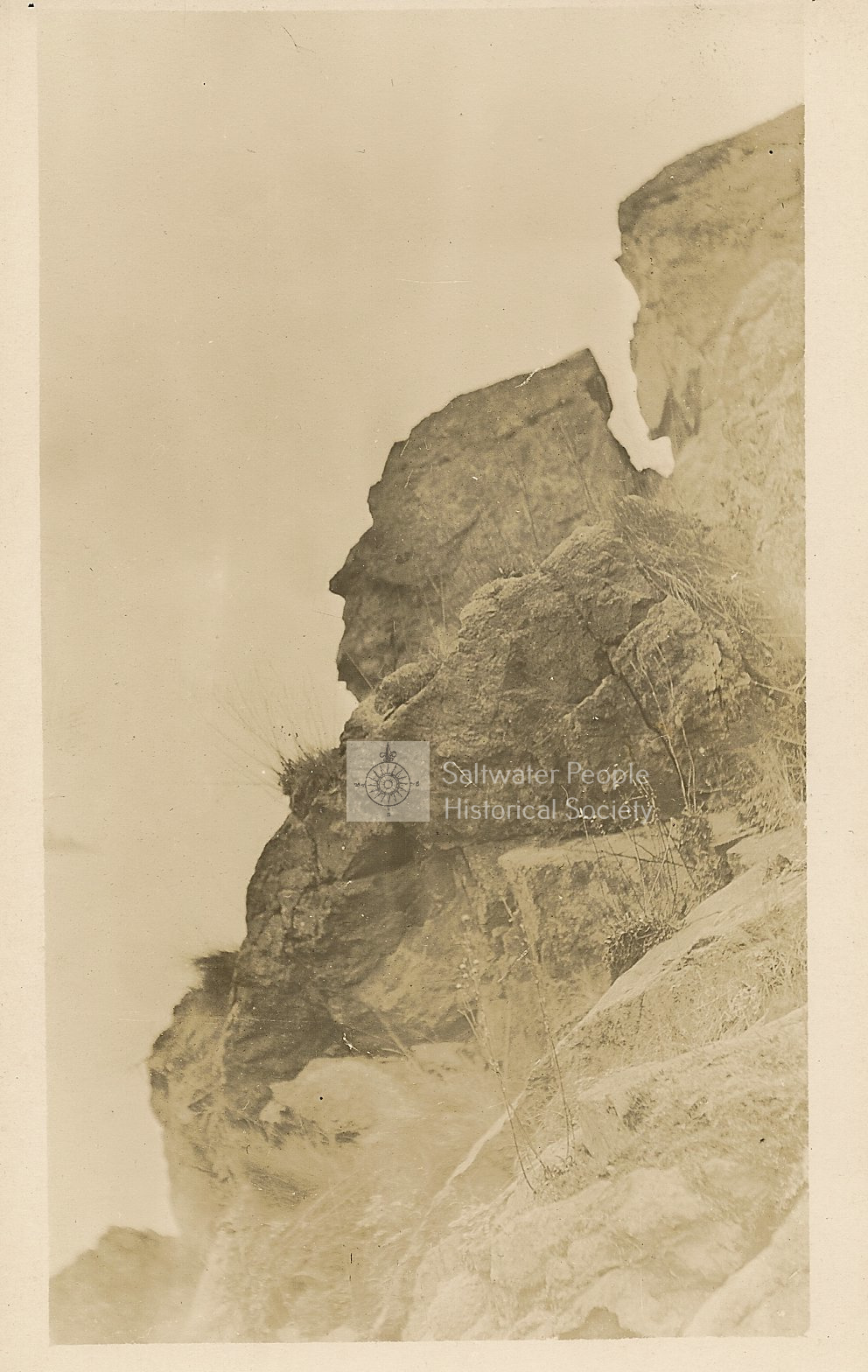
We climb up into the woods and around the outer bluff of the island to find Washington's profile. 


Washington's profile
A rock formation on Lopez Island
that went by several names.
June Burn mentions the
landmark in this essay.
Click image to enlarge.


We find the bluff where the face used to be, but something seems to have happened to the nose, or else we have not come to the right place.

But we find dark blue camas in bloom. And against an old abandoned house a gorgeous lilac heavy with purple flowers. The woods are full of wildflowers. Lady slippers, Oregon grape, starflower. Soapalalee will be along presently. From these berries, the Natives make a bitter foam which some call Native ice cream.

Across the island, is John Thompson's big lonely house where the white-headed old mariner lives alone. He promises to take us with him to Smith's island next Monday. 

The Mud Bay schoolhouse and Eaton's pretty home. On up and around to the Vogt loghouse built a half-century ago of alder logs mind you. Inside, an old square piano, hooked rugs in original designs, and handsome ship models made by the son while tending fishtraps. Outside, flowers and blossoming fruit trees and green meadows and the forest not a hundred yards away. A lovely place.

Well, you needn't think I can go all over the whole island in one letter! See you tomorrow. June"

June Burn. Puget Soundings May 1930


18 December 2020

❖ NO ROADS? With June Burn ❖


CHICKAWANA
San Juandering with writer June Burn on 
Orcas Island, San Juan Archipelago, WA.
Click image to enlarge.
From the archives of the 
Saltwater People Historical Society©


In the old days, there were no roads. Many now living can remember when the first wagon was driven from Olga to East Sound. "No limousine ever looked so bright and beautiful and luxurious," said one of those early settlers.
      I suppose the earliest settlers boiled over from the Fraser River goldrush into this section as they had come to the Olga neighborhood. Mr. King, who settled here over 45 years ago, said he came to Orcas instead of to Whatcom county because it was so easy to get here. There were no roads back into the vacant land of Whatcom in the early 1880s, but the road to the islands has always been clear. Somebody had told him he ought to come to see the islands. He came, he saw and was conquered, and he and his wife live yet in the cedar log house which he built down by the bay way back yonder in 1885 or '86.
      We drove in the 75-cent moon down to the King Ranch, going on up first to see the moon path across Cascade Lake and saw instead the long white tracks where the skaters had been.
      This beautiful house, built of squared cedar logs, stands as securely as it stood forty years ago, the very same mortar perfectly solid in the chinks. Mr. King and a helper got the cedars out of the woods, squared them with an ordinary ax, set them up, and finished the house in two months. Logs go all the way to the points of the gables and inside the house, the walls are whitewashed logs, very attractive. Even the cracks in the logs (not between them) are interesting, and the huge fine old square piano set against one of these handmade walls books perfectly at home, as if music were no hifalutin' snob.

      On the wall inside the piano hangs a panel on which five pairs of deer horns are mounted. Mr. King killed them all one night thirty years ago, though he says he shares the honors with his wife. "Yes," she agrees," I held the lantern while he shot them and I stumbled over one dead deer after another following after him and I got my skirts bloody." The deer these days ate the gardens faster than the settlers could eat the deer. The Kings were raising strawberries and blackberries for the market. Also, there was road work. These two slender sources of income plus the garden and the deer made up their living. The schools lasted only three or four months, Mrs. King used to teach the school at Doe Bay for $23 a month and her board. When the three-month term was out then she would come over to East Sound and teach for another four months. At Doe Bay, she used to board around between the Vierecks, the Moores, and the Greys, walking to school of course--walking, if need be, all the way to East Sound.
      The mailman used to walk, too, with his pouch of mail on his back, following that long road three times a week. Sometimes he rode what Mr. King calls a cayuse.
      

Eastsound, Orcas Island, 
San Juan Archipelago, WA.
Click image to enlarge.
Original photo from the archives of the 
Saltwater People Historical Society©


      There used to be a lime quarry near East Sound and the limerock is still there in paying quantities. But a syndicate bought up the land, stopped work for some reason, and so we still have as much limerock as ever. Shattuck kept store in the old days. He had a bolt of calico, a strip of bacon, and a pair of overalls," and what else was there to want?
      The Kings have lived off the land a good deal trying to keep up with their children in their goings and comings. But now that the children are all settled the two young old people have come back to the log house where they spent their first years together. Mrs. King is busy piecing a quilt of the pattern "glittering star," her stitches tiny and many. There are the flowers, too, and the grapes, the garden, the wood-getting, the canning and a swarm of things to keep them as busy as they used to be, and I declare they seem as happy as any young couple I ever saw just starting out. I tell you, there is some magic about this pioneering way of life which for the right people makes the most real happiness anybody can know.
      It was the gayest, warmest sunniest morning of the "cold spell" when I took the Chickawanna once more to go on to Orcas another village at which I had never stopped. East Sound slipped back against the bright background of island green as the little boat clicked off down the bay and disappeared as we rounded the west prong of the big island. There are worlds of interesting things and people at Olga and East Sound which I have not mentioned but there will be times again to come San Juandering. See you tomorrow. June.

June Burn 
Puget Soundings
22 January 1930

07 July 2020

❖ Sluckus from the Upper Islands ❖ with June Burn.


San Juan Archipelago
including Spieden Island where the author
June Burn homesteaded with Fararr Burn.

This card courtesy of publisher Smith-Western Co, Tacoma, WA.©
from the archives of the Saltwater People Log.
Apologies for taking so long to coax June Burn back to share another of her soothing stories through the northern islands she knew so well. 
   
      "The little group of upper San Juans around the Canadian line is a favorite resort of the Natives. They can find as much employment as they want cutting cordwood in the winter, fishing in the summer, and resting a good deal between jobs. The Native women lead lives of purest romance and maybe you think they don’t know it! My neighbor, who employs them off and on his farms, will admonish a wife of one of his workmen, urging her to stay at home more and prepare suitable food for her husband who is working hard at the wood cutting. He doesn’t make any progress to speak of! She will grunt, maybe smile sheepishly, maybe even make some sort of reply. But she won’t stay at home and cook. Not she!
      Early in the morning of a day sunny or gray–– what difference does the weather make?–– Native women can be seen out trolling up and down the channels. A woman-full dugout canoe rowed, maybe, by one little 6-year old boy and his 7-year old sister, will glide around the point, head in to the beach for no apparent reason, and deposit its entire human load. Perhaps to go berrying with little buckets and cedar bark baskets. Maybe they will gather sluckus if the tide is out (sluckus is a narrow, long, leaf-like sea plant that grows on the rocks and which may be gathered at low tide on most of the rocky beaches. I believe it is sea lettuce, though am not sure.) They may build a small fire and boil something or other in curious kettles. They may only sit around and talk or hunt agates among the various colored gravel of the beautiful beaches. I wish I did know what their comings and goings mean.
      Right now, I see Old Katherine, fat Isaac’s wife, sitting up on a yellow grass bank hunkered over her knitting tending a miniature campfire. Her colorful washing of blue work shirts and pink petticoats flaps on a line behind her. The youngest born of one of the women out fishing in a nearby channel lies in a little box near Katherine. She is “minding! it. And meanwhile of what is she thinking? Neat and tidy is Katherine and something of a leader among them, I think, though there again I am on unsure ground.
      I’ve grown so accustomed to seeing the Natives around the islands I know best that it wouldn’t be coming home if they were not here now. Stewart Island’s nearness to the Canadian border keeps them here. They sell their sluckus in Victoria, whence it is shipped to China for soup. They get 10 and 15 cents a pound for it dried and sometimes return to America with 30 or $40 worth of gaily painted washpans, calico, outing flannel, fancy china, and who knows what all else stowed away in their cedar dugouts. Relatives live on the Canadian side, also, which keeps them visiting back and forth across the line. Further down the islands one hardly ever sees a Native save as their dugouts or motor launches pass back and forth in the channels.
      Once, when the boys and I were summering on Johns Island, General and his family, with old Isaac and Katherine, decided to go up to the Sucia Islands to gather sluckus. General came up to my cabin to ask me to take care of his chickens while he was gone. I promised, but later discovered he had taken them with him, fearful, perhaps, that I might forget to look after them a mile down the island from me.
      They pulled out early one morning on a fair tide around my end of Johns Island out into the channel towards the Sucias. In General’s thirty-foot dugout five people sat on the bottom of the boat or on thin narrow slats across the edge. Besides the family, there were two boxes of chickens, one of a hen setting on her eggs and the other of the hen whose five chicks had just hatched. There were tents and bedding, cooking things, and boxes of food, a crippled lamb donated by Spieden to be killed for food, every personal belonging of both women of the family, and sacks in which to gather the sluckus. It was the fullest boat ever I saw. And to top it all, in the bottom there lay the flat rocks on which they would build their little campfire in mid-channel and cook their food in the boat while it was moving along.
      Two weeks later the family returned, General who had done the bulk of the rowing, looking thinner than ever and very hungry. They had got a hundred pounds of sluckus for which they would receive a fourth of what they would have made if they had stopped at home and cut cordwood. But that was not the point. Gathering sluckus to sell for lots of money was only an excuse. Romance was the main crop, although they did not know it. They perhaps don’t bother to say in words what it is that drives them through terrific tides after little dabs of sluckus or clams or fish and it may be that they don’t question themselves at all. But I’ll bet old Isaac could phrase it if he chose!
      Hello, high bluffs of Spieden! This long mountain ridge up thrust high and steep above the water is the first island we knew. Its people neighbored and fed and transported us in homesteading days. The very tip of the three-mile-long island was itself, homesteaded many years ago by a naturalized soldier from the English Camp, Robert Smith. To have climbed so high to find his perch proves that he loved hard things. It is his daughter who lives there now, never having known another home. She has running water and electric lights now and radio and piano and automobile and boats and wealth. But the marvelous scape of sea and island and sky and snowcapped mountains from the top of Speiden is what holds her there. See you tomorrow. June."
June Burn. Puget Soundings. The Bellingham Herald. 26 October 1929.

09 July 2019

❖ ADVENTURES WITH CAPT. TARTE ❖ June Burn in 1930

From Military History Now. 
"The adventure in which young Jim Tarte was involved in Victoria, was far more serious than a mere thirty-six-mile row on the Strait of Juan de Fuca at its maddest. Even if that trip had meant death to him it would still have been less serious than the incident I am about to relate now. 
      It used to be the custom in the English navy to flog naughty sailors at 4 o'clock in the morning. Many was the time the Tarte family had heard the screams of some poor devil getting his daily dozen from the cat-o'-nine tails out on a man-of-war a mile away from Victoria. Perhaps recollections of those horrible early-dawn sounds made young Jim more willing to engage upon the dangerous job of helping one of those sailors due for such a flogging.
      The chap, a marine, was a body-servant to one of the officers. It being the custom for officers to use the enlisted personnel thus. The officer was especially overbearing, exasperating. One day the marine, suddenly unwilling to endure any more, lifted his hand to strike his master, thought better of it quickly, lifted the motion into a salute. But the officer, knowing what was meant, reported him. He was court-martialed, sentenced to be whipped and turned adrift on a hatch grating with a day's supply of food and water. 
      His fellows asked young Tarte if he would aide them to help the fellow to desert. Plans were made. Somehow they got the irons off his arms, got him ready for the rowboat. 
      'My brother and I rowed quietly alongside,' Captain Tarte says. 'They dropped his little bundle down into the boat and then dropped the marine down and we made off to the shore. When we got on land the fellow offered me $10 but I refused. I made him hold up his right hand and swear that he would touch no drop of liquor until he was out of the country. If he had spent his money for liquor, he would have got drunk and have been caught as others had been. I suppose he kept his promise. I never heard from him again. That was the only time I ever helped a deserter. It would have been five years for me if they had caught me doing it.'
      When the summer in Victoria was over, Jim bought himself a light rowboat, put it aboard the steamer Enterprise, came up the Fraser River to Ladner Landing, had himself set down with his boat. There he hired a yoke of oxen and a sled and hauled his boat to Boundary Bay when he rowed home to Semiahmoo in 1871. Later he sold that boat for $20 to a man down at Bow. 
      In 1872, young Jim shipped on the historic General Harney, owned by Capt Roeder, captained by Mason Clark. Jim was mate.
      In those days the boat would anchor in the mouth of the river at Marietta in eighteen feet of water. Ten years later the river silt had filled in the harbor eleven feet so that the water was only seven feet down. Today [1930] trees grow where the old General Harney used to stand at anchor! That seems incredible and is due, doubtless, to the increased washing from the hills because of their being logged. Bellingham waterfront has been filled in, too, but mostly by artificial means. All manner of buildings stand along our bayfront where ships used to lift and fall with the swells.
      Jim Tarte went off to Seattle for another job on a boat.
      The first thing he got at Seattle was a job loading lumber on Yesler dock. A big Siwash took the end of the lumber on the even side of the pile, leaving the smaller man the far more arduous job of handing the odd lengths. In two days he was done up. A wreck. The captain of the Colfax was looking for a man. When Jim applied the captain cursed him, said he was looking for a man and not a ghost, but ended by giving the young lad a chance. 
      Thus began two years of steamboatin' with one of the roughest old captains whoever came to the Sound.
      See you tomorrow." June Burn. Puget Soundings. April 28 1930.

Jim Tarte (c. 1850-1933) served as mate on steamers COLFAX, ADDIE, NELLIS, DESPATCH & others. His last command was on the steamer BESSIE and his last active service was as mate on the tug DANIEL KERN to Clallam at age 80 years.


03 August 2018

❖ Captain Tarte Remembers ❖ 1930


Capt. Tarte's last paying work was on
the DANIEL KERN 
R to L: 
DANIEL KERN, 
RICHARD HOLYOKE, 
PROSPER, PURITAN, PEERLESS, 
and LEWIS II, 
dated on verso 1914.
DANIEL KERN (ex-MANZANITA)
was built in 1879,
in Norfolk, Virginia as a US Lighthouse tender.
She came to the Pacific Coast in 1885.
She was rebuilt for towing rock barges to
the Columbia River jetty.
In 1918 she was bought by WA. Tug & Barge.
She had a compound (16,34 x 24) compound engine
with steam @ 100 pounds pressure from a single-ended
Scotch boiler, developing 300 HP.
Bellingham Tug & Barge of B.L. Jones 
purchased the steam tug in 1924.
 She was burned for scrap at
Richmond Beach, WA. in 1939.
Photo from the archives of the 
Saltwater People Historical Society


"... he remembers Bellingham when it almost wasn’t. He watched our Sound cities grow from forests to forests of houses and skyscrapers. He has seen the baker’s dozen of folks who were here in the middle of the nineteenth century grow into hundreds of thousands of people.
      He says to all the goers and comers on the Sound, Bellingham is known as the livliest town in the NorthwestIts incomparable Harbor is large enough for the whole fleet with a holding ground not to be excelled, and secure from winds except along its northern rim. Bellingham leads in business progressiveness, in resources. He says that just as fish and timber have boomed us hitherto, are still enriching us, so will minerals and oil boom and enrich us steadily down the decades.
      The first money little Jim Tarte earned in America he got peeling bark off trees, selling it. The last money outside his little estate out on Lake Whatcom was earned as mate on the DANIEL KERN last summer towing logs from Clallam Bay. He pays a high compliment to the captain of the tug.
      “Why that young fellow, Davis, who is captain of the KERN, is only 29 years old, but he knows more about his job than many an old pilot. He is one of the most proficient masters I ever saw. They tell me he is studying for his deepwater license. He’ll get it. He’s a live one.”
      “But for that matter, the company for which he works is one of the livest concerns I ever knew. It started from scratch and in just a few years has built up the finest little fleet of big tugs on the Pacific. How they keep those boats so ship-shape I don’t know. The DANIEL KERN and all of them look as if they were just down from the dock all the time. It’s marvelous how it is done. Neat as a pin. A well managed company.” 
      My captain has shipped on some thirty-six boats during these sixty-five years, with seven dollars as his only bill of damage in the whole time. From deckhand, fireman, flunkey, he has risen to become mate, purser, pilot, master, captain, skipper of ships of unlimited tonnage. He has watched boats and me come and go until at last there are but a handful of the old salts whom he remembers from the old days.


Captain Charlie Basford,
fondly remembered by Capt. Tarte,
 aboard the
GOVERNOR ELISHA P. FERRY,
the first patrol vessel built for
the WA. State Dept of Fisheries.
(Later in her life she became a trap tender.)
"Capt. B," a highly regarded captain
in the PNW, who landed on
Shaw Island as an orphan
 in the 1800s to live with the old
whaling ship captain, C.C. Reed
and his wife on Blind Bay.

Photo courtesy of the Bruns/Stillman family. 

One of these is Capt Charlie Basford, who ran the BUCKEYE in the islands. Cap’n Basford began his sea life as a deckhand on the DESPATCH. He learned the island waters and their ways as few have known them, and never had an accident. My hero calls him one of the finest men, finest masters, who ever ran a boat.
      My captain says that he would like to get into a rowboat and traverse every mile of the routes he has taken in all of his boats. He would like to take that first fifty-mile row from Victoria to here (Bellingham) via Shaw Island. Would like to repeat that hazardous journey across the storm-swept Strait of Juan de Fuca and would like to follow every line of every route he has ever rowed, sailed, steamed, on these waters he loves tremendously.
      I think I have never spent more delightful sessions with anybody than these long evenings I have sat in Capt Tarte’s living room listening to him spin yarns. I am sorry they have ended. If there have been any mistakes in names or dates, blame my notes, and the speed with which I had to take them down. Capt Tarte’s memory is remarkable, his desire for accuracy is great."


Above text by June Burn. Puget Soundings. June Burn. May 1930. There are many other essays by June Burn on Saltwater People Log, reached by searching her name label or that of Puget Soundings.

Captain Jim Tarte and his tug BRICK can be seen on this Log HERE

09 April 2018

❖ POINT ROBERTS COUNTRY ❖ with June Burn 1930

METSKER'S MAP OF PUGET SOUND COUNTRY©
Copyright of Thos. C. Metsker
"Metsker the Map Man."

This map is for convenience not for navigation.
Click image to enlarge for viewing Pt. Roberts.

"The village of Point Roberts is called West Point Roberts. It stands down in the lower lefthand corner of the peninsula. Here are two or three stores, gas stations, a big fish cannery. Behind one of the new stores, there stands a thirty or forty-year-old building with "Bureau Salon" in big letters across its false front. There are several houses, of course, one little hotel called the Green Lantern, another restaurant, a schoolhouse and nameless relics of houses whose uses I do not know.
 
      Jutting out into Georgia Strait from the beach is the long dock. The daily boat, TULIP, from Bellingham, stands off here to discharge mail and freight. Beyond the beach a mile or so, fishtraps look like centipedes floating on the water. The high derrick affair up northward is one of the boundary monuments set there to let fishermen know when they are on their side of the fence.
      It stands over a mile from shore, I believe; 5,500-ft to be exact. I suppose there is a light atop as there is on the one ashore. The international boundary makes a sharp bend two or three miles out from Pt. Roberts and turns southeasterly down Georgia to Haro Strait when it bends again through Haro to Juan de Fuca and so on out to sea. It really is too bad that it doesn't turn southwesterly from Boundary Bay and so avoid this bit of peninsula altogether. It must be a great bother keeping up customs and boundary patrol for six square miles or less of country. Though it does add interest to our map to see Pt. Roberts away up there at our northwesternmost corner separated from us by both land and sea. It is more than an island, surrounded as it is on three sides by water, and on the fourth by an alien country.
 
      Summer people, week-ending visitors, are already trickling down to all the long, sandy beaches of the Point. They look very carefree, walking like Pippa on her one holiday of the year. Very jaunty and satisfied they look, as if they had achieved some private victory of their own.
      At the village, I found Mr. Culp just ready to go home. He brought me back to the cottage in the woods, and this evening after supper all of us crowded into the coupe.
      Down to Boundary Bay, we went past Baker's new charming log cabin, past the Russell place, along the narrow graveled road with shrubs pressing in from both sides, past the Ellis Johnson place. Honeysuckle in bloom in the woods. Mrs. Culp told of the effort that their local Grange made to stop the vandalism of wildflowers and shrubs in the summertime. They wrote Olympia about it, learned that tree stealing could be prosecuted, but apparently not other forms of the ruthless gathering of wildflowers.


      Leghorn Heights on our left, and the Solomon ranch. Crystal Waters beach. Is it not a lovely name? Thorstenson Ranch and the Goodman place deep in the woods. Down to White Lily Point, which is a high bluff overlooking the bay. Here, in March, the little white six-petaled Easter lily droops her sweet head under every salal shrub, every frond of Oregon
grape. In bloom now are vetch, wild roses, Indian Paintbrush, honeysuckle, fritillaria or rice-root, and many little things whose names I do not know.
 
Eight photographs from the archives of the
Saltwater People Historical Society©
      Across Boundary Bay the lights of Blaine, below the bluff fifteen fishtraps with long curved leads. Far down across the Strait, Lummi Island, and Orcas. The big P.A.F. fish cannery at the foot of the high bluff has not run for years. Mr. Arni Myrdal is in charge of fishing operations down there. Wise in Icelandic lore he is, they say. But I did not meet him on this trip. See you tomorrow. June."
Above text by June Burn. Puget Soundings. May 1930.

13 January 2018

❖ RICHARDSON to SMITH ISLAND ❖ with June Burn, 1930

Richardson store and oil dock, 1958.
Lopez Island, San Juan Archipelago.
Original photo from the archives of the Saltwater People Historical Society©
"Off to Smith Island with Capt. John Thompson of the little boat JEAN G. Down the slender strips of gravel between rail fences, the island lying trim and narrow north and south, the sea and its islands falling away to the east and west.
      Down into the cup of the island past Hummel Lake, glittering in the sun, the sun on grass, on plowed fields.
      The tide is out so that when we reach the dock at Richardson we must climb down spikes driven into a piling and so onto the deck of the Jean G.
      The captain takes aboard supplies for the radio and lighthouse tenders on Smith Island. In a few minutes, we are chugging southward towards the isolated dot lying off Whidbey Island, Island County.
      On our starboard bow Woody Island (called Buck Island on my map) with its 'Chateau' built to hug and straddle and fit the snags of a big gray rock. As we leave the scant protection of Woody and Long Islands to go rolling and plunging into the great swells of Fuca the captain lashes down his tender, his freight and whatever is loose on deck. There is a wind from the southwest to augment the swells so that we do considerable rolling and wallowing, now on top of the long hummock of a wave, now in the cradle between two such peripatetic ridges. The Captain stands on his short, stocky, seaworthy legs apparently unconscious of the roll. But I can't stand up at all.
      Halfway to the island, the eclipse of the sun darkens the world, but we have no smoked gasses through which to see the shadow of the moon swing leisurely athwart that golden prow.
      As we approach Smith the captain points out Minor Island that at very low tide is a mere spit but between which and Smith the JEAN G. can go at extreme high tide. Thus casually does land become island or peninsula and I used to think an island was fixed geographic identity!
      Capt Thompson makes four trips a month to this small fifty-acre island stop which a great light guides wayfaring ships. He brings the mail, supplies of food, instruments sent out by the government to the lone exiles who tend the light and the radio and the compass.

SMITH ISLAND
Light was first shown at this station 18 October 1858
This is a few years after June Burn's visit on the JEAN G.
USCG Photo from the archives of the Saltwater People Historical Society©
As we come around the spit to the dock on the south side of Smith, we see the whole population of eight or ten persons waiting on the beach. For the mail. The captain takes the mail in the first boatload of us and eager hands grab it. One man empties the box, scatters the letters on the ground and in the lee of the boathouse everyone stirs the pile to find his own. In a half a minute or less every man and woman is holding an open letter in his hand, reading. Other letters wait between the fingers for their turn.
      Mail every eight days! It isn't so long to wait if one is frantic with hurry and work. But if one is living in such comparative solitude with so few contacts and such exacting tasks, eight days is an eternity.
      We climbed the always immaculate circular stairs to the light in its dome. From there all of Puget Sound in a magnificent scape of land and sea. Mt. Rainier and the Olympics to the south. The Cascades, Baker, and blue foothills eastward. The Canadian Coast range across the rim of the north and the hills and mountains of Vancouver on the west. I thought if I strained my eyes around that slow bend of Juan de Fuca that I might see the ocean itself but I couldn't. What a spot in which to work! What grandeur in every direction! For all its solitude, its loneliness I think I'd like keeping the light on Smith Island.
      We went into the compass room where an operator is on duty day and night. A ship in a fog can send out a request to be located and the compass man will place him with nice exactness. No big boat equipped with radio need ever pile up on rocks. If the pilot is in doubt he can get his exact position. Of course, the trouble is that the pilot isn't in doubt and so he doesn't bother asking for a position and thus occasionally finds himself piled up of a gray foggy morning on a bleak craggy rock.
      Everything on Smith Island is trim and neat. The whole island looks like a big private lawn with a little cluster of willows in the middle. The winds shriek there and the very grass is put to it to hold its roots. But what a place to live! Let's go into lighthouse service! Thank you, Captain John, for a memorable experience. See you tomorrow, June."
Above text from Puget Soundings. Burn, June. 1930

(Sorry, no photo of the Jean G. on file.)
There is a post on Saltwater People Log about the salvage and removal of the Smith Island Light by Leiter Hockett working for historian Jim Gibbs HERE
      If you'd like to read more about the history of this lightstation, Historian Lucile McDonald wrote an article published in Puget Sound Maritime's Sea Chest journal of September 1981. It has been posted on this Log HERE

02 December 2017

❖ ABOARD LITTLE SOUND BOATS ❖ June Burn 1930


ISLANDER
, Obstruction Pass,
between Orcas and Obstruction Islands.

Original photo by James A. McCormick from the 

Saltwater People Historical Society© archives. 

I am off San Juandering again. I have always dearly loved San Juan Island, Speiden, Stewart, Johns, Sentinel, and Cactus Islands, and supposed Orcas and Lopez and the rest could not possibly be so nice, or their people so friendly and lovable.
       But just as soon as each little bay and each high sunny point is peopled with friends these other islands will become precious, too. And so for the first time, I'm off to browse among the gnarled madronas to climb the high hills, to see the far views of Orcas.
      I never come aboard one of these little Sound boats but I marvel that I've been able to stay off them for so long. How is it I've walked city streets, turned the pages of dusty books, talked about business things when all this time these little boats are going up and down, up and down, and I not aboard one of them? How do we resist the lure of these channels and the wheedling appeal of island coves?
The sun is warmer out here on the bay, the wind softer, the lift and fall of the waves sweeter than the nicest swing father ever made.

SAN JUAN II

With winter weather,

scan courtesy of Charles Torgeson
©
       
The Chickawana has taken the run of the San Juan II with the Tulip King to pinch-hit for the Chick. We did not come past the old hulk of the San Juan, where she lies naked and broken in Peavine Pass, but I heard stories of her last trip. One said she was driven ashore a scant few feet from a sharp ledge off which she would have gone to the bottom and all with her if the sea had not carried her to safety. But from the crew of the Chickawana, I could get no stories. Maybe they want to forget that wild night. Or maybe it was all in a day's work to them. But certain it is they won't talk much about it though you'd think each of them would have a tale all made up trimmed with thrills and horrors. The adventure of a shipwreck is wasted on folks who don't know they've had one!

OLGA DOCK, ORCAS ISLAND, WA.

original photo from the archives of
the Saltwater People HIstorical Society©

      I left the boat at Olga, the second stop on Orcas, the first being Doe Bay. The sun shone brightly on this new snow of the dock but icicles tinkled on the edges of the north wind and I was glad to find the fire in the big fireplace of the hotel kept by Mrs. Alexander and her daughter, Fairy Burt.
      I had stopped at Olga to see Mr. Ferri, the great artist of whom lately I'd heard and whom I met one day on a Bellingham street. But he is gone now and his pictures gone, too. A fire in his studio a few weeks ago destroyed pictures and sketches and dreams of a lifetime. His studio had burned to the ground and I did not go to see the ashes. He is gone too, though I think he will be back. For the sun still shines on this matchless point of earth and the Olympics still notch the horizon to the south. Who has once loved and lived in such a spot cannot long stay away. Mr. Ferri is not an old man for all his long years of work and his pictures were but the body of his dreams--the essence of them is here yet. Please come back to the islands Mr. Ferri, wherever you have gone, and trap some of this beauty on canvas again! The radiance is wasted upon just us who without an artist's eyes cannot see a complete glory.
       A chance encounter had given me the acquaintance of Dr. Madison, also of Olga, a physician, and writer. So that failing to find Mr. Ferri I still had one small excuse for stopping here. What was my surprise and delight, upon telephoning Mrs. Madison, to be invited to a dinner being given that evening to local friends. Nowhere else in the world, perhaps, would it have happened. Nowhere else have there been such things to eat. And nowhere else could I have gone in breeches and boots to dine with ladies in velvet. Nowhere else have stories that went round that table, of deer eating up the cabbages in the game warden's garden and he says all he can do about it is to plant more next time! See you tomorrow. June."


Archived Log Entries