"The Cure for Everything is Saltwater, Sweat, Tears, or the Sea."

About Us

My photo
San Juan Archipelago, Washington State, United States
A society formed in 2009 for the purpose of collecting, preserving, celebrating, and disseminating the maritime history of the San Juan Islands and northern Puget Sound area. Check this log for tales from out-of-print publications as well as from members and friends. There are circa 750, often long entries, on a broad range of maritime topics; there are search aids at the bottom of the log. Please ask for permission to use any photo posted on this site. Thank you.
Showing posts with label Roche Harbor. Show all posts

25 October 2024

LOG OF THE M.V. INDIAN – 1948


The M.V. INDIAN
dated 23 May 1948, 
home dock, Seattle, WA.
One or both twin brothers 
 were on board the Indian for this trip
north and caught this shot  on the waterfront
at 5:30 a.m.
Click image to enlarge.
Original photo signed by
Bob and Ira Spring,
from the archives of the 
Saltwater People Historical Society.
©

"Fifty-two ports along the 2,000 miles of Puget Sound shoreline receive regular calls from a small fleet of freight boats, and another 50 had docks at which occasional stops were made. The boats traveled south to Olympia and Shelton, and north to Bellingham and Powell River, B.C. The fleet had six boats, the Indian, Lovejoy, Seatac, Belana, Warrior, and Skookum Chief. The third name is derived from Seattle and Tacoma and the fourth name from Bellingham and Anacortes. The freight boats were of shallow draft. Most of them had a large lower deck that ran the full length and width of the boat. The freight was loaded on small sleds at the warehouses. These sleds were carried aboard by gasoline-driven lift trucks and placed on the long, lower deck. At the ports, the process reversed, the freight-laden sleds carried off to the docks. The boats carried crews of 12, including the skipper, other officers, deckhands, lift-truck drivers, and last but far from least important, the cook. 

Want to take a trip on one of these boats? Here is a sample log of the motor vessel Indian on one of its trips to Bellingham and the San Juan Islands, Washington State.

Monday, May 23 1948

5:30 a.m. left Pier 53, home dock in Seattle, loaded with general merchandise for Anacortes, Bellingham, and other ports. A photographer aboard.

6:15 a.m. Point Wells, unloaded empty oil drums and took on full ones.

10:50 a.m. Headed through the swift waters under Deception Pass Bridge.

1:20 p.m.


Arriving Bellingham waterfront
1:20 p.m. 
where the well-konown Osage was tied up.
Photo by Bob and Ira Spring
From the archives of the 
Saltwater People Historial Society©

Tuesday 4:53 a.m. 


The Indian slips into Friday Harbor,
San Juan Archipelago, WA., 

4:53 a.m. as logged by the 
photographers, Bob/Ira Spring 
for this amazing shot. 
Click image to enlarge.
The M.V. VASHON is standing by
on the left border 
watching over new arrivals.
Original photo from the archives of the
Saltwater People Historical Society©


7:40 a.m. 

The INDIAN arrives at 7:40 a.m.
at Roche Harbor,

San Juan Island, WA., 
 to load sacks of lime 
from Roche Harbor Lime Works.
This original photo is dated May 1948
but the photographer is unknown.
Click image to enlarge.
From the archives of the 
Saltwater People Historical Society©


9:45 a.m. Headed through Pole Pass (225 ft wide) between Orcas and Crane Island.
11:10 a.m. Arrive Anacortes, Skagit County, WA. The last stop on return home. General merchandise was unloaded at Anacortes Port dock."
From an article published by the Seattle Times. No byline.

Crew and officers aboard:
Homer Stroup, Master
Arie Millenaar, Mate
Merrill Fleck Quartermaster
William Carlson, Chief engineer
Other crew: M.H. Roen, Clyde Durham, John Barr, Erwin Duly, Clarence Ostrom, and cook Helen Scott

27 July 2019

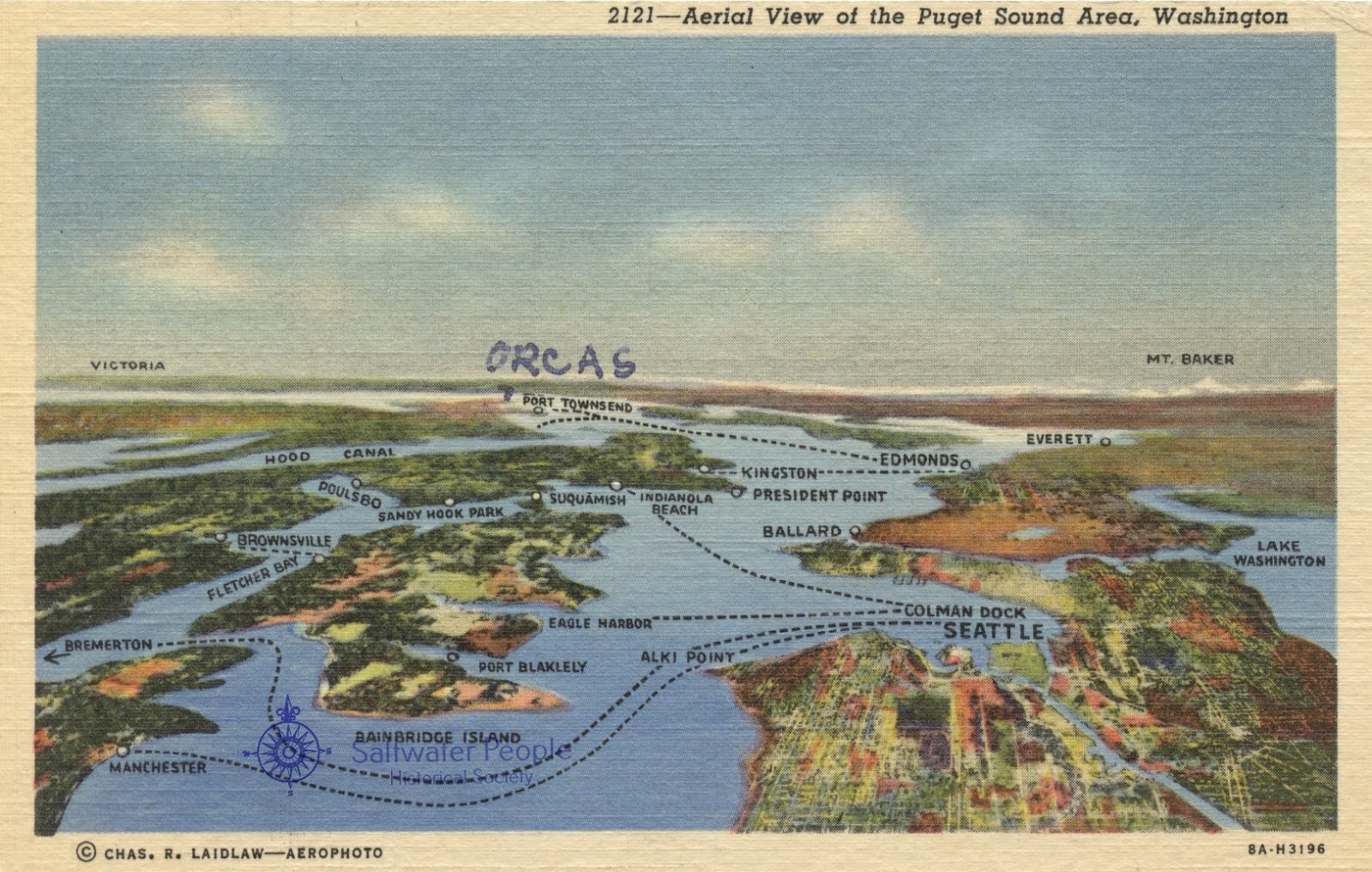
❖ SHIPPING OUT FROM SAN JUAN COUNTY

Puget Sound Ports
leading to the world.
Click map image to enlarge.
Getting closer to home,
Click the image to enlarge.
Map cards from the archives of the
Saltwater People Historical Society©

"From the first records to the present day the fishing and its industry have always been a most important factor in the development of this county. About 1850, numbers of small fishing sloops would fish around the southerly part of San Juan Island. They would anchor in what is now charted as Griffin Bay [formerly San Juan Harbor.] They prepared their fish for salting in barrels, that they sold to the Hudson's Bay Co., at Victoria, B.C. This being such a convenient haven some of them built shacks ashore and as the number grew, small schooners would come and gather up the barreled fish. This was probably the first freighting out of the islands. The shantytown grew and a man called Captain Higgins put in a small stock of supplies. Fishermen wrote letters and left them with him for mailing to Victoria. They gave as a return address, 'Victoria, care of Capt. Higgins, San Juan town,' and thus was born the first town in the county. Many Native American maidens kept house for the fishermen. In time there were two stores with liquor in the backroom, and rooms to rent on the upper floor, and fairly regular mail service. This first town was finally abandoned and was later destroyed by fire, but during the days of the boundary dispute, it was a lively place and high-life a-plenty.
      The fishing industry had a steady development. A fish saltery was built near Friday Harbor. A few years later it was destroyed by fire. Shortly after this loss a packer from the Columbia River, named Develin, built a cannery at Friday Harbor, San Juan Island. Fish traps were introduced and many of these made big money for their owners––and on the hush-hush, they often made money for the fish-pirates, too. 
Fish trap fishing
Pacific Northwest Washington.
The top photo is a trap in Point Roberts, WA.
Click image to enlarge
.
      It was quite a welcome income from the outside. Many of the piles were gotten out in the county and most of the traps were manned by young men from the growing families in the county. 


FISH TRAP LOCATIONS IN
NORTHERN PUGET SOUND
DATED 1913.
Click image to enlarge.
Fish trap 
westside of San Juan Island, WA.
Click image to enlarge.
From the archives of the
Saltwater People Historical Society©
At one time there were some 40 odd traps in the county. They were finally legislated out of existence. [1934]
      The first seiners were all hand-operated, but the advent of gasoline-powered engines soon put them out of the running. 
Puget Sound seine fishermen
hand-hauling in the net.
Low res scan of original photo dated 1943.

From the archives of the 
Saltwater People Historical Society©
The first powered seiners were a big advance, but no one could foresee that someday we would have the wonderful seaworthy and comfortable boats that now comprise the seining fleet. What with seiners, trollers, gillnetters, and the reefnet gears, [and the early fish traps], it seems a marvel of nature that there are enough fish caught to keep all this vast fleet in the black.
      
Reefnet fisher Ed Hopkins.
Day's end on the fish boat,
one of the pair of boats
comprising his gear #7.
Squaw Bay, San Juan County, WA.
1980s.


Fish in the net,
Gear #7
Squaw Bay,
Shaw Island, WA.
Ed Hopkins and
crew Jim Sesby.
Click image to enlarge.
Photos courtesy of gear owners
Ed & Kathy Hopkins.
      One of the very interesting operations is a reefnet gear. It is an operation originally used by the Native Americans, and boats and methods of fishing very much the same as it was when explorers like Captain Gray, Vancouver, and others first witnessed and described its operation. 
      At one time there were seven or more canneries operating in this county, now there are only two in this year of 1953.


Friday Harbor Waterfront
Undated.

      Quicker transportation, modern transportation, and machines that are so marvelously skillful and tireless have made a great change in the canning industry. Now, too, the top market for the highest grade is here in the United States. At one time the highest prices were obtained in England. In the early 1900s, a British bark was towed into Friday Harbor cannery and loaded most of the pack for delivery in England. In those days the humpbacks were not even canned, but thrown overboard, thousands and thousands of them.
      Lime is one of the major natural assets in the county and has made a major contribution in the wealth and development of San Jan county, and probably bids fair to outrun all industries, other than agriculture. Many an early settler while clearing his land and getting his farm in shape, was glad to put in off-time at cutting and hauling cordwood for the lime kilns.

      
Lime manufacturing
Roche Harbor, San Juan Island
Click image to enlarge.
Original photos from the archives of
the Saltwater People Historical Society©
There have been many changes in methods of packing and transportation of lime. The bucking and falling saws have given way to the chain saw and the cordwood wagons drawn by so many handsome draft horses have been entirely displaced by trucks; but the firing of the limestone is still a matter of heat, wood, and work.

      The first lime was probably burned by some of the English soldiers who were familiar with the industry. They built some small pot kilns and barreled the lime they made in empty beef casks and traded it to the Hudson's Bay Co. With the packaging of the lime, there came quite a development in coopering. This, too, was a gainful occupation that could be worked at during the off days from the seasonal farm work. Nearly all the early steamers were wood burners. The cutting and hauling of cordwood to the different boat landings furnished a considerable payroll. No one in those days would have believed that there would be ferry boats or any craft over 250-ft long making daily trips through the Islands. And what of the future –– who knows."
Words by Mr. Frank Mullis., from a pioneer family of San Juan Island, WA. for the Friday Harbor Journal Nov. 1956. Maps, chart, photographs from the archives of the Saltwater People Log. 
      

20 March 2015

❖ ROCHE HARBOR BUILT ON LIMESTONE ❖

DAY 72 from 100 Days in the San Juans by author/historian June Burn, under contract with the Seattle P-I to write these columns in 1946. She sailed among the islands camping with her husband, Farrar, in their little San Juanderer.

      Many folks interested in regional history have written about the limestone at the hideaway of Roche Harbor, on San Juan Island, San Juan County, WA. Here are words from the revered June Burn.
      

Roche Harbor, San Juan Island

As it was in 1948, just two years after June Burn
published this article.
Photographer unknown.
Original photo from the archives of the
Saltwater People Historical Society©
"Roche Harbor is known for its great hill of lime rock and the purity of the lime that is burned from it. It is known for the wonderful flower garden in front of the old Hotel de Haro, and the McMillan family, who have managed the company ever since there was a lime works here. People have heard of and many have seen the unique copper-roofed tomb where the McMillan ashes are buried.
      All over this northern part of the archipelago, people have sold barge loads of wood to the lime company, or sold eggs and milk and fish and fresh meat to them, or have broken rock for them. They gave Farrar the first job he had when we came out here to homestead Sentinel. People have been born and grown up and married and had grandchildren still in the service of the Roche Harbor Lime Co. In its heyday, the elder McMillan [John Stafford] used to give great annual harvest festivals that were three days of eating and jousting as in ancient times, really. He did love to do things dramatically!
      There is a novel to be written about this village and company. Its story cannot ever be told in all its color and drama except in a book. No mere column could hope to touch it.
      As you go into the harbor, past Pearl Island, you get a fine sweeping view of the lime rock quarry, very high on its hill to the right; big piles of white waste––the cleanest waste any manufacturer has. The lime kilns, next against a hill where the clematis grows, then an old warehouse in which the cooperage used to be.
      The store and wharf come out in a long row into the harbor, but grass grows now in the eaves and the old three-masted schooner no longer stands there waiting for its load.


Looking down on the busy limestone manufacturing 
port operated by John S. McMillan
Original photo by Brady from the archives of
the Saltwater People Historical Society©
      To the left and above the store, are the hotel and the manager's house; below them, the garden of roses and carnations, of gladioli and an arbor of wisteria with vines as thick as Scarlett's waist; at their left the windowy pink house where Paul McMillan now lives.
Gardens at Roche Harbor,
undated.
Original photo from the archives of
the Saltwater People Log©
      The schoolhouse stands on its own knoll above the road.
      Swinging around to the left, as you enter, the company houses go in rows, most of them now empty. But they may all be full again, sometime, when production gets underway again,, although most of the people who work at Roche Harbor nowadays live at Friday harbor, with a bus to bring them to work in the mornings.
      Roche Harbor is famous for the largest lime works in Washington and also for the fact that this is the purest lime to be found anywhere. It is over 98 % calcium carbonate.
      McMillan, in the scientist's guarded way, calls this a "large accumulation of limestone," but one of the company managers once told me that there's lime here for a hundred years. This land was bought from the Verriers, who moved to Orcas.

Abandoned limestone quarries and kilns,
 Roche Harbor, San Juan Island, WA.

Photo by artist Parker McAllister dated Jan. 1959.
Original photo from the archives of
Saltwater People Historical Society©
      Here comes the milk truck. Mrs. Martin unloads her bottles for Roche Harbor. We buy seven quarts. Bottles and cases were shifted on the truck to make room for us and the girls and we set out for English Camp.
      It is a fresh morning, not too hot; the road is graveled. It dips now and then into green woods and yellow fields and then it lifts to overlook blue waters and islands. Finally, it turns down to Garrison Bay, where...
We'll be seeing you, June."


07 September 2013

❖ ROCHE HARBOR RESORT ❖

Book Review

The Building of Roche Harbor Resort by the Tarte Family: Neil Tarte in his own words.
Narration by Neil A. Tarte (1927-2014) to Mitzi Johnson. 

Roche Harbor Resort, San Juan Island, WA.

Large photo dated 1956.
Originals from the archives of the S. P. H. S.©
"Mitzi Johnson, a long-time resident of Friday Harbor, captures Neil Tarte's words and tone in this delightful book of the history of Roche Harbor Resort during the years that the Tarte family owned it (1956-1989).
      Mitzi had promised Neil's devoted wife, Margaret, who died in 2007, that she would help Neil write his memoir. The first edition was published in 2010. Their recorded conversations are so carefully transcribed that you sense Neil himself, is explaining this story to you.
      Reuben and Clara Tarte, Neil's parents, came to the San Juan Islands in their yacht, CLAREU II, in the 1930s to find that there was no safe place to tie up a yacht––except to pilings. About 20 years later, when they purchased the 4,000 acres and 12 miles of coastline from the McMillin family, they could envision a boater's marina. None existed anywhere.
      All that was left were several buildings from the Roche Harbor Lime and Cement Co (earlier, a Hudson's Bay outpost), workers' cottages, and the McMillin home, along with a crumbling Hotel de Haro.

Hotel de Haro, Roche Harbor Resort
Winter 1958-59

A beauty parlor, snack bar, and gift shop 
were installed in the old Hotel. 
Salmon barbecues with 
Indian dance programs were staged for tourists.
Houses for miners' families were filled with motorists.
Original, dated photo from the 
Saltwater People Historical Society©
      It took all the muscle the family had with Reuben, Clara, and Neil, at the helm, to build this magnificent resort. Neil's family and close friends all played a part in turning this 'jewel in the rough' into a location where people would want to come and stay.
      With determination, as they needed things, they would find a way to get them. They were able to restore the crumbling Hotel de Haro into 20 guest rooms (including President Theodore Roosevelt's room). 

Colors Ceremony, 

a tradition begun by Reuben Tarte (1927-2014)
It is performed at dusk every night during the summer,
and familiar to all Roche Harbor regulars.

Photo by Gordon Keith.

From the archives of the S. P. H. S.©

They developed the McMillin family home into a restaurant and bar and added an outside deck and gazebo. They obtained a liquor license, turned Roche Harbor into a major port of entry for US Customs, and also added a 4,000-ft airstrip.

British blockhouse, June 1960
A favorite boating and beachcombing area 
for guests and off duty employees
in Garrison Bay,

a short trip south from Roche Harbor. 
Stopping at the most famous landmark, 
were four young Roche Harbor employees, 
Gwen Bergh, Betsy Neighbor, 
Bill Brilliant, and Kelvin Vogel.  
The blockhouse dates from ca.1860.
Original, dated, photo from the archives of the S. P. H. S.©

       Readers will be reminded of long-standing San Juan Island family names. John Wayne would bring his yacht into Roche Harbor in the 1970s, and 'the Duke' would welcome flotillas of visitors. Neil Bay, named after Neil, has been the picturesque neighborhood for dozens of families all these years. The Roche Harbor gardens, designed by Neil's mother, Clara Tarte, delight thousands of visitors annually; many weddings are booked there.
       Today, one takes for granted this beautiful location, but the blood, sweat, and tears that went into creating it are worth reading.
      You'll feel like Neil is just telling you what happened."
Review courtesy of writer Suzy Mygatt Wakefield, April 2012.
Tarte, Neil. The Building of Roche Harbor Resort by the Tarte Family. Illumina Publishing 2010.
The Building of Resort book search 

The four photographs with captions in this post are from the archives of the Saltwater People Historical Society©.


05 January 2012

❖ THE STEAMER TOURIST ✪ ✪ ✪ By Captain Ed Shields

The TOURIST 
by Seattle photographer James A. Turner, undated.
Original from the archives of the Saltwater People Hist. Society.©

The TOURIST
Undated image saved in the Joe Williamson collection,
most were purchased & archived by Puget Sound Maritime.

Original from the archives of the Saltwater People Historical Society©
"The TOURIST was a sternwheel steamer used to transport passengers and freight to various points in Puget Sound. She was shallow draft with dimensions of 156.8' x 27.9' x 7.6'. She was built in Port Blakely in 1907, owned at that time by the Puget Sound Navigation Co. When new, she was placed on the Bremerton-Port Orchard route. She was a handsome vessel with a tall, slightly raked smokestack, huge sternwheel and high pilot house at the forward end of the upper deck. She was painted white. The upper deck was fitted with comfortable chairs and benches while freight was confined to the lower deck.
      In 1929 she was extensively rebuilt to serve as a freight vessel. Her shallow draft, requiring only four-feet of water, made her fitted for the Seattle-Mt. Vernon run, where she could navigate up the shallow reaches of the Skagit River. An elevator was installed on the forward deck; she also operated in the cross sound auto-passenger runs during the early days of auto ferries. The cars were loaded via the elevator with the TOURIST being moored alongside the wharf. The auto was driven onto the elevator by one of the crew members, the elevator lowered and the auto driven back into the freight area. The same scheme was employed in off-loading. The auto passengers were not in the car when loading or unloading.
The INDIAN 
freight boat owned by Puget Sound Freight Lines,
 moored here at Roche Harbor, San Juan Islands, WA.
Her house was from the sternwheeler TOURIST.
Archives of the Saltwater People Historical Society©
      In 1937, the TOURIST was laid up for the last time. The pilothouse was removed and installed on the new motor freighter INDIAN of the Puget Sound Freight Lines Co.
      The TOURIST was typical of several early freight and passenger vessels, being fitted with a sternwheel instead of with propeller as present vessels are equipped. Vessels of this type operated with a very low-pressure boiler and the exhaust steam from the engine was discharged out the smokestack, in a manner similar to the exhaust system used by steam railroad locomotives. She did not have condensers. In the early days, the boiler fires were stoked with slab wood from the many sawmills in the area."
Text by Captain J. Ed Shields. About the Boats.

Archived Log Entries