"The Cure for Everything is Saltwater, Sweat, Tears, or the Sea."

About Us

My photo
San Juan Archipelago, Washington State, United States
A society formed in 2009 for the purpose of collecting, preserving, celebrating, and disseminating the maritime history of the San Juan Islands and northern Puget Sound area. Check this log for tales from out-of-print publications as well as from members and friends. There are circa 750, often long entries, on a broad range of maritime topics; there are search aids at the bottom of the log. Please ask for permission to use any photo posted on this site. Thank you.

27 May 2013

❖ PIG WARRIOR of 1859 ❖

American Camp Troop station,
San Juan Island, Washington Territory.
Photograph of a sketch by an unknown artist.

Courtesy of B.C. Provincial Archives © for L. McDonald, 1960.
Photo from the archives of S. P. H. S.
"A bill introduced in Congress in January 1965, proposing that the federal government purchase 1,800-acres on San Juan Island and create a national historical park commemorating the Pig War, has set several persons wondering what became of the man who started the trouble.

      Percival R. Jeffcott, Ferndale, WA historian, and Ray Jordan, Sedro Woolley member of the Skagit County Historical Society, are among the latest to inquire into the subsequent career of Lyman A. Cutler, who fired the shot that set off an international boundary dispute lasting 12-years.
      The future park would pay tribute to the powers of arbitration, for no blood was shed, except that of the porker.
      Lyman Cutler, after having raised a crisis that spread far beyond the bounds of the potato patch where he found a British hog rooting, did not remain long enough in the island to learn whether they were to be English or American. He was living on the mainland when the decision was reached.
      Jeffcott, who believes he has tracked down Cutler's burial place south of Bellingham, recently told of his findings in a talk before the Ladies of Kiwanis group in that city. He said he has every reason to conclude that Cutler was interred on Deadman's Point, which later was hydraulicked into Bellingham Bay and that the pig warrior's last resting place is beneath industrial plants on what is now known as Commercial Point.
      Cutler, a Kentuckian, aged 27, was among the first dozen American squatters on San Juan Island, arriving in April 1859, presumably after a disappointing experience in the Cariboo gold rush in B. C. He staked a 100-acre homestead claim on what is known as the Fraser place, facing American Camp Road near its intersection with the road to Mar Vista.
      A contemporary described him as 'one of the unwashed sovereigns of the United States who did not scare worth a cent.' Another recalled he was 'tall, light-haired, fine looking, fearless, adventurous, and full of fun.' A third said he set up housekeeping with a native woman in a structure that was a cross between a tent and a hut.
      Cutler is credited with having made a round trip of considerably more than 40-miles to Dungeness by sailboat to purchase a sack of seed potatoes for $30. He dug up about a third of an acre in the midst of a Hudson's Bay Co sheep run and sowed his spuds.
      It is a marvel that a pig was the only one of the company's livestock to find them; several thousand sheep, 40 cattle, 35 horses, and 40 hogs, grazed at large on the south end of the island. The potato patch was fenced only on three sides; the terrain it occupied was part of Bellevue Farm, which the company had operated for six years.
      On the morning of 15 June, Cutler saw the pig nuzzling among the potatoes, chased the animal into the nearby woods, and shot it. When the encounter was reported to Charles Griffin, manager of the farm. Cutler said he had been assured by American authorities that he had a right to the land, it was American soil, and he and other squatters would be protected by the US government.
      A boundary commission, then at work, had not yet decided on which side of the international border San Juan lay. Until the point was settled, Griffin considered Cutler and his ilk trespassers. The manager at once sent a letter to his superior in Victoria. Before it reached its destination he received unexpected support. The steamship BEAVER came in from Nisqually with A. A. Dallas, the company's chief factor, on board.
      The latter paid a call on the Kentuckian, told him that he had killed a breeding boar valued at $100 and intimated he had better pay for it or stand trial.
      Cutler did not like the tone of the ultimatum. To him the animal was worth no more than a common razorback; he professed a willingness to settle for $10. Evidently hot words were said on both sides. Cutler later reported Dallas 'insulting and threatening' and Griffin was heard to remark that the Americans were a pack of intruders and he had been a fool ever to let the first one remain.
      What happened after that is well known. Brig. Gen. William S. Harney, calling at the island on a tour of Puget Sound defenses, heard a highly colored account of the episode and dispatched Capt. George Pickett and 68 infantrymen from Fort Bellingham on 27 July to protect the Americans and prevent any attempt to carry Cutler off to Victoria for trial.
      At the urging of fellow settlers, Cutler made himself scarce for some time. His friends were afraid he might get trigger happy and kill any British subject sent to arrest him.
      Conflicting accounts exist as to what happened next. Paul K. Hubbs, Jr, American customs officer on the island, said that Pickett's first act on San Juan was to order Cutler's arrest and that Hubbs was deputized to go and get the culprit.
(L-R) Ships SATELLITE and ACTIVE.
Photo of an undated sketch made on a hill on San Jan Island,
looking toward Lopez Island and Mt. Baker.


"San Juan town is a lost place beside a beach on San Juan Is.
It is not even a ghost town, nor are there piling,
decayed log foundations, or broken bricks, to mark where it stood.

Yet it was once the principal port and the noisiest, most lawless,
and most troublesome spot, in the San Juan group.
 It lay downhill southeast of American Camp,
close to Griffin Bay, and at the south end of a pond.
" L. McD.
      The same day the British warship SATELLITE anchored off Griffin Bay to land John De Courcy, who had been appointed magistrate to try the case on the island. The British officers were surprised to find American troops already on San Juan when its ownership was under arbitration by the boundary commission.
      Pickett, one step ahead of the game, had appointed an American justice of the peace, Henry R. Crosbie. The latter, in a report to Washington, took credit for advising Cutler to place himself under Pickett's protection. The pig shooter acceded, to the relief of everyone.
      Crosbie said that Cutler was in custody only one day. Hubbs insisted in an interview late in his life that Cutler never was tried by the authorities on either side. British reports present a different view. The captain of the SATELLITE said that Pickett told him on 31 July, Cutler was given a court hearing, fined heavily, and the amount would be paid to the Hudson's Bay agent to compensate for the loss of the boar.
      That September, Hubbs helped Cutler phrase his story of the shooting in a favorable light, laying the firing of the shot to 'a moment of great irritation'. Cutler in the statement sworn to before Crosbie said he had expressed a desire to replace the pig at once.
      Cutler at first gained prestige from the episode. He was elected constable by the Americans on the island and later served as a deputy sheriff, a post he was holding in May 1864. Then he disappeared from the San Juans.
      The next one hears of him, he was 39 years old, unmarried, and living in Samish precinct in April 1871, with John Gray, a fellow Kentuckian, and logger. Jeffcott discovered that Cutler took a squatter's claim a short distance south of Blanchard, north of Bow in the northwest part of present Skagit County, 'east of the William Wood place.'
      In 1874 Cutler became sick and moved to a hotel on Bellingham Bay to be near to a doctor. Jeffcott thinks it must have been in Sehome. On 27 April 1874, Cutler died, leaving an estate of $489.75 to which his father, brother, and sister in Michigan, were heirs.
      Among his belongings, sold on 13 June at an administrator's sale, Jeffcott learned from county probate records, was the shotgun with which Cutler was said to have used to kill the pig. D. P. Thomas purchased it and many years later sent it to the Washington State Historical Society, where it now reposes. It was brought out last fall [1964] and displayed at a park hearing in Friday Harbor."
Above writing by Lucile McDonald, author/historian;
The Seattle Times, 30 May 1965.
Last page from The Pig War
by Betty Baker
Harper & Row, New York, and London, 1969.
Library of the S. P. H. S. 


25 May 2013

❖ WASHINGTON STATE FERRY AGROUND AT ANACORTES❖


WSF ferry HYAK, 
14 April 1986,
Captain Terry Lee
Location: reef near the ferry landing,
Anacortes, Fidalgo Island, Skagit County, WA.
Photo by Richard S. Heyza for the Seattle Times©
Original photo from the archives of the S. P. H. S.

Like its sister ships the ELWHA, the HYAK will go down in San Juan folklore for running aground. Unlike the ELWHA, the HYAK's tale of woe is not romantic.
      The HYAK ran aground not because of a lady in the wheelhouse but because of paint in the wind and a captain's concern for the working conditions of his crew.
      Skipper Terry Lee was trying to keep the wind off workers while they were painting the outside of the deck. So after stopping at Lopez, he headed to Anacortes without turning around, as usual, to keep the wind to their backs.
      When he arrived at Anacortes on schedule at 10:40 AM he swung the boat in toward shore before heading away from the landing so he could "back" in.
      The boat got too close to shore and went aground on a reef a few hundred feet from the dock, ferry spokeswoman Pat Patterson explained.
      Chairs slid to one side, a video machine that was not secured wobbled, and riders were caught off balance. Some vehicles slid into each other on the car deck and were damaged.
      There was a minus 0.6-foot low tide at 1:37 pm at Anacortes, so the water beneath the big boat continued to drop. The vessel tilted until it had more than a 15-degree list. A tug secured a line and pulled to help keep it upright.
      The boat sat there, helicopters and planes buzzing around all day. Finally, at 6:30 pm when rising tides and two tugs worked in tandem, the HYAK came free. 
      "It was like a fair ride––when we first hit, the deck started going up and up. It felt like an earthquake. The whole boat shook," said Tim Thomsen of Friday Harbor, who returned to San Juan on the 7 PM ferry.
      "They announced for everyone to put on life jackets. That was scary. Then they said not to abandon ship until we were told to. That was really scary," said Marty Robinson of San Juan.
      Response to the crisis was excellent, riders said. The Red Cross showed up. The ferry system paid for some inconvenienced customers to stay overnight in motels. The system paid for meals and long-distance phone calls.
      Ferry officials also took photos of every vehicle so the damage could be recorded.
      Patterson said she expects claims to come in soon. Several vehicles were damaged slightly. No one was injured. Two persons were taken to Island Hospital to meet their doctors' appointments.
      Patterson said the ferry system is investigating the mishap. The HYAK will be put up on blocks in Seattle. A rudder and propeller appear to be damaged.


WSF M.V.  HYAK, 
at Todd Shipyards 
18 April 1986.
According to Don Schwartzman,
 ferry system marine superintendent, 
new plating may be needed for 
a 40-50-ft gash in the hull.
Photo by Vic Condiotty for the Seattle Times©
Original from the archives of the S. P. H. S.
The superclass ferry could be back in service next week if the damage is limited, Patterson said.
      The ELWHA (that ran aground off Orcas in 1983), was called in to replace the HYAK temporarily.
      From the air, the mammoth ferry looked uncomfortable leaning on one side with a line extending to a tugboat that was keeping the ferry from listing any further on the reef, about 200-ft from shore.
      "It's really listing," said pilot Si Stephens, who flew circles over the boat with county commissioner Doug Corliss. 
      There were 250 passengers and 127 vehicles on the ferry when the mishap occurred. Passengers were evacuated by a Coast Guard ship, a fishing vessel, a tugboat, as well as by lifeboats [from] the ferry.

Above text by Allison Arthur, Friday Harbor Journal, 16 April 1986.

Washington State Ferry HYAK:
1967: One of four superclass ferries built this year at National Steel and Shipbuilding Co.,  San Diego, CA.
382'2" L x 73'2" B x 18'6" D. Four diesel-electric engines. 
2,704 G.t./ 1,214 N.t. (admeasurement)

      A reporter from the Seattle Times wrote that there were only four 15-passenger life rafts on the HYAK at the time of the stranding.
If anyone was a passenger this day and would like to leave a comment, it is easy to do in the space below this post.


17 May 2013

❖ FAIRHAVEN CANNERY DAYS 1904 ❖ ❖ by Lynn McKee


Early Fairhaven, WA.

Photographer P. L. Hegg

From the archives of the S. P. H. S. ©

"My family brought me to Spokane in 1892 when I was very small; in 1904 we moved to Fairhaven, now South Bellingham. I was 12-yrs old, and for vacations we school kids used to go to the canneries asking for jobs, as there was no child labor law at that time. I'd be hoping the ‘China-boss’ would come out and ask, "you want work?"
  The canneries in those days were the Washington Packing Co at Fairhaven, R. A. Welsh, Pacific Packing & Navigation Co (later Pacific American Fisheries), Sehome Packing Co, Astoria & Puget Sound Packing Co, at Chuckanut Bay, and one saltery belonging to Thompson Fish Co.
P. A. F. Cannery 

The canning firms paid 7 to 10 cents an hour to boys piling cooled cans of salmon that had been cooked the previous day. They were wheeled out of retorts on cars that held 6 trays of tall cans, or maybe 11 to 13 trays of half-pound cans. They were cooked 90-minutes at 242-degrees, then Chinamen pulled the cans out on tracks to a warehouse, where the cans would cool overnight. The cars and trays were wanted back as soon as possible, so doors were left open to catch a breeze and cool the cans. School kids were hired to pile them as high as they could reach. The warehouse looked like a sea of cans; all night one could hear them snapping as the vacuum sealed them.
The only adult labor, around the cannery itself, was the old Chinese; they were hard-working and willing. I remember how one of them would come out from the 'China House' every morning wearing a shoulder yoke from the ends of which hung two huge cans of tea. He'd leave one of them in the warehouse for the workers. They didn't want kids standing around the pot, but we thought we should have a break also. The Chinese had a job keeping us steadily at work.
After the end of the canning season, the stacked cans were all cooled when the Chinese lacquered them with crude brown varnish thinned with naptha. This was done in the lacquering machine. The kids' job was to pick cans off the pile and lay them lengthwise on a track that slid them toward the machine. They were immersed in lacquer six or eight at a time then dumped out on conveyor chains and carried over a fan in the machine where a blast of air-dried them. The Chinese removed the cans and we kids re-stacked them to await shipping orders. Labels were applied by hand; the cans were then packed in wooden boxes that had been made at the cannery before the season opened.
Things were just beginning to be modernized and the lacquering machine was the first real improvement. Cans were still all made by hand when I got my first job in 1904. I was sent to help at the soldering bench. The Chinamen prepared their own solder in long sticks. I carried trays of side soldered can bodies to where the bottoms were soldered on. I also learned how to make complete cans from sheets of tin plate.
Around the plant were still the old vats for washing cans in lye water to remove oil after the final 90-minute cook. They were put out to dry and then the Chinese sat around and painted them red. It was explained to me that England was a great outlet for our canned salmon. When the cans were shipped through the tropics and around the Horn in sailing ships on the way to Great Britain, they would sweat and rust. If a can wasn't painted red when it got to England, it wasn't salmon. So before lacquer came in as a rust preventive, the cans were painted.
After I had worked a while at the WFA Co, the China boss took me to a pile of salmon in the fish room and told me to supply fish to the hand butchers. He gave me a picaroon and said, “you put fish on table. If table not kept full, you got no job--savvy?”
This is where I was working when Edmund Smith came from Seattle with an experimental butchering machine he wanted to try out.

"The Iron Chink," circa 1906.

It was considered the most important
of many machines used in fish canning.

 The machine butchered 65 salmon per minute.
According to Galen Biery and Dorothy Koert
in Looking Back, the machine was still being 

 manufactured in 1980, by Smith-Berger Co, Seattle.
Photo from the archives of the S. P. H. S.© 

Smith was the inventor of the "Iron Chink" and I sometimes ran errands for him. Because of the work, I did for him, when he perfected the machine some years later, I became contact man for the company, traveling the AK coast.
In my early years around canneries, Puget Sound fishermen used seine skiffs. They were big dories, square on one end, and could carry a crew of four to six. The men would put a tent on a beach and row out with the dory, carrying the net on the stern. To make a set they cast it off and rowed in a circle. Then they pulled in on the lead line to purse the net and brailed the fish into the boat.
About 1912, I was an engineer on the BEAVER, owned by R. A. Welsh of the Bellingham Can Co. I hadn't intended to work on a cannery tender, but the company had trouble with engineers getting drunk and asked if I wanted a job like that. I went to the Y.M.C.A. and took a gas engine course before I said yes.

The BEAVER

She tended the first steam pile driver in
San Juan county in 1894.
The pile driver was owned by Kinleyside,
Richardson, Lopez.

Original postcard from the collection of the S. P. H. S. ©

   The BEAVER had been built in Anacortes about 1894 and was 65-ft long. She had a 50-HP Troyer Fox gas engine when gas engines weren't common. I was told there were only two on the northern part of Puget Sound. We made up our batteries for ignition with sulphuric acid and carbon-zinc plates in glass jars. Welsh used the boat to pick up fish for the cannery and to take the pile-driver crew out to his traps. We would go to the San Juans and pick up fish from the little camps on the beaches. There were lots more fish in those days and they were caught most anywhere.
William Bell was captain and deckhand on the BEAVER and I was an engineer and cook. We lived on the boat. My bunk was alongside the engine and under the deck. When rain fell the deck leaked and my blankets would get wet.
Our season started about March with driving piles at West Beach and Strawberry Bay. A crew was ashore on Cypress Is at Strawberry Bay making up the web, then we towed it on a scow to where needed. In the fall we took the scow down again and picked up what was worth saving of the web. The pile puller pulled the piles and the good ones were taken to Strawberry Bay, where there used to be a dock and buildings of the main camp.
The company had two or three traps on the west coast of Whidbey Island, one at Strawberry Bay, and three in Hood Canal, at Lofall, Whiskey Spit, and Bridalbeck. I can remember going to these traps to pick up a scow load of humpback salmon then on the way back we ran into a storm and had to pull into Bowman's Bay until it was over. With only 50-HP the skipper had to work with the tides.
Mostly our runs were with a hold full of fish. We also transported men back and forth to the traps and camps.
There were no fish tickets at that time; payment to fishermen had to be in cash. The skipper went to the Fairhaven bank and got a canvas bag of bills and change, which he stowed under his pillow. He slept with a Winchester in the bunk alongside his right leg. One night when anchored in a fog I heard the skipper yelling his head off and when I got on deck he was standing at the bow shaking his fist at the fog. He had been hijacked and robbed before he could get his rifle out.
Another exciting time was when we went ashore in fog on Bird Rocks. We thought the BEAVER was going to turn over because she was at such a steep angle, so we got out and sat on the rocks, wondering what we'd do after the tide came in. However, as the water rose the boat righted, and we got back on board.
We had a peculiar experience on another occasion when we were heading out and halfway across Bellingham Bay. Suddenly I got three bells and a jingle, the signal for full speed reverse. The sudden reverse killed the old engine and when I looked out there was a periscope coming up across our bow. A sight like that gives you a queer feeling.
The explanation was simple enough. The Electric Boat Co was building two submarines for the Chilean government and picked Bellingham Bay for the trial runs. We were nearly hit by either the EQUIQUE or the ANTAFOGASTA. One of those submarines came up under a log boom in Hale's Pass; the skipper looked back and saw the logs standing on end.
Back when I began in the cannery business there was no electricity. The cannery was lit by lanterns, fish were unloaded on a platform at the dock, and pitched from there up to the cannery floor. The first fish elevator in the old plant was put in the year I went to work; its power came from the streetcar line. One of my first jobs was to sort through the fish and throw the chums overboard. It was thought their meat was too coarse and only suitable for salting. The old WPC didn't do any salting. England bought only sockeye salmon. Down on the Columbia River, the canneries saved big chinooks and packed them in oval cans. I remember the biggest king we picked up weighed 60 pounds. Anybody could have carried it home; it wasn't wanted for canning and it went to the China House.
Such were early days in the salmon canning industry on the Sound. The old BEAVER served us well. I last saw her moored among other fishing boats at Ketchikan."
Above text by Lynne McKee, as told to Lucile McDonald.
From The Sea Chest, the March 1975 quarterly journal of the Puget Sound Maritime Historical Society, Seattle, WA.

14 May 2013

❖ NORTH'S NORTH STAR ❖

NORTH STAR, Deer Harbor, Orcas Island.
Built 1930, by boatbuilder Chet North,
who sailed her into this port and never left.
Only known photo, saved by his Deer Harbor neighbors. 

"In 1911 Thomas Fleming Day, editor of Rudder magazine, sailed the 25-ft yawl SEA BIRD from the US to Italy,  single-handed. 
L-R: Frederick B. Thurber, T. R. Goodwin, Thomas F. Day
in 1911

Aboard SEA BIRD before their trip to Italy.
Library of Congress Photo (LC-B2-2207-9)
      A near copy of the boat plans appearing in the magazine, caught the eye of a multitude of people, one of them being Chet North, then living in Portland, OR. 
     In 1930 he completed a 22-ft copy of the vessel, with the addition of a 1928 Chevrolet engine, for more dependable arrivals.
     The boat was trucked to Olympia, WA for an October launching, along with one large police dog, the two senior Norths, and a new wife. Chet had just married Averil; on Halloween night they all set off for Canada, heading into a freshening northeaster. The first night was spent on McNeil Island.
      In December while returning from BC, they stopped for an overnight in Deer Harbor and never left.
      Only one picture was ever taken of the boat and that was also the only time that all sails were up; the engine having proved too handy. This photograph was found among the Pearmain family's collection of 'unknowns'.

The remains of the boat were, and perhaps are still, in the blackberry bushes on the Coffelt property on Lopez Island." 
Text by mariner/historian L. W. 'Corkey' North, son of boatbuilder Chet North, 2006.
This image from The Rudder, October 1901.
The magazine founder, editor, and boat designer was
Thomas Fleming Day, as mentioned by the author of this log post.
There is a detailed article about TFD and his work in
Wood Boat magazine No.43, Nov./Dec. 1981.


11 May 2013

❖ The Sails of a Stately Lady ❖ The NIPPON MARU ❖ 1957

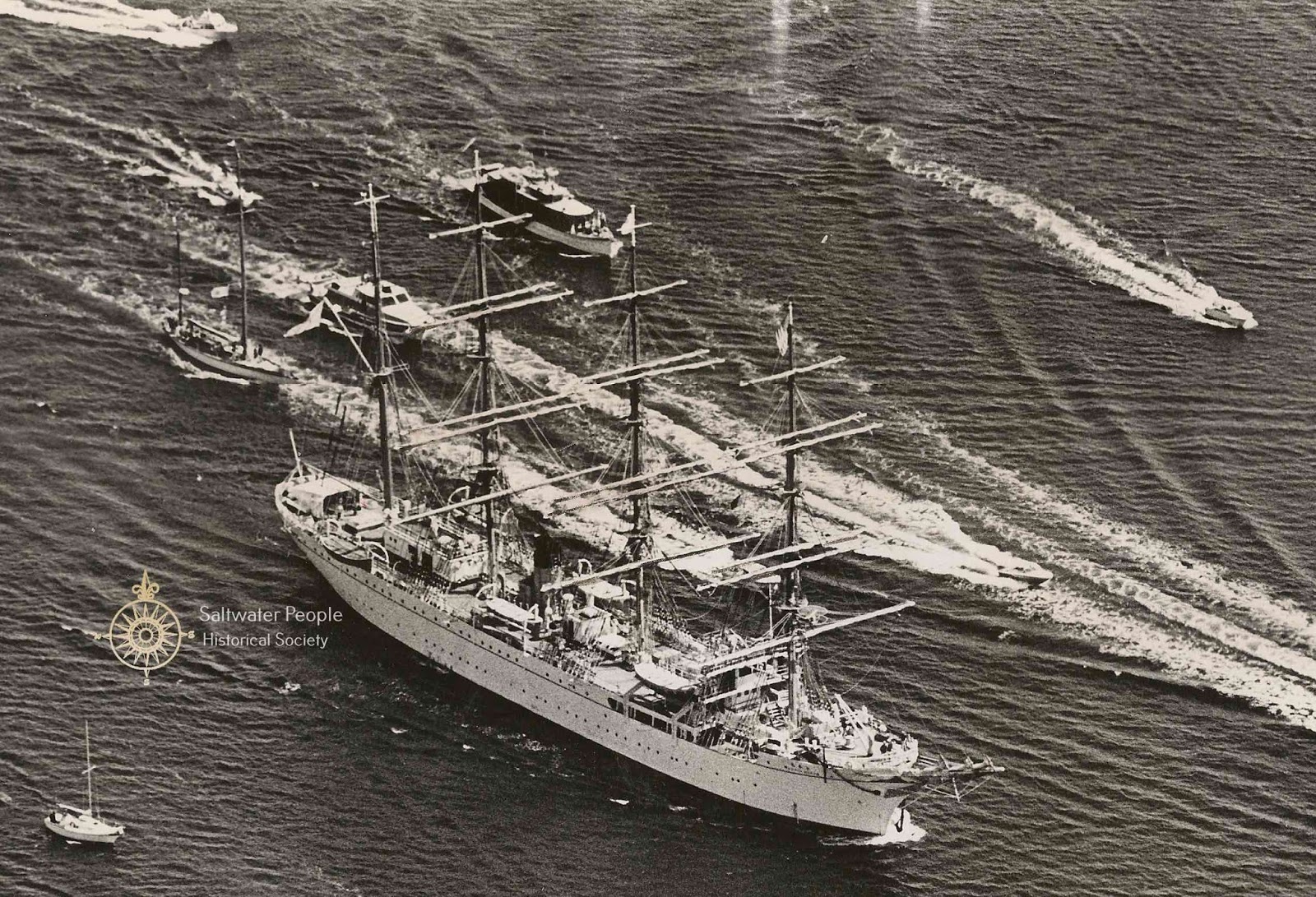
NIPPON MARU
Arriving Seattle 1957

NIPPON MARU
Arrival in Seattle, WA
For Seafair 1978.

According to the Seattle Times reporter, 
she could make 14.5 knots under sail,
faster than her Diesel propulsion speed of 11.4.

Photo by Larry Dion©
Original photo from the archives of the S. P. H. S.
      The magnificent, four-masted, steel, Japanese merchant marine training barque, the 318-ft  NIPPON MARU carrying 32 sails with 25,727 sq ft, en route to a Seattle pier. 
      She was built in 1930 by Kawasaki Shipbuilding in Kobe, Japan for the Imperial Japanese Navy; rated at 2,285 g. tons with a maximum mast height of slightly more than 176-ft. The ship carries 183 men, 20 officers, 112 cadets, and 51 crewmen who would perform sail drills for the huge crowds and open the ship for viewing. 
     
Nippon Maru
Seattle, WA., 1978.

Photograph by Larry Dion.
Original from the archives of the S.P.H.S.©


      Her good-will visitations to Seattle were 1938, 1941, 1957, 1962 for the World's Fair, 1965 with Capt. Isao Ikeda at Pier 56, 1973 with Capt. Shosaku Kadama at Pier 91, and 1978. Traffic stopping conditions existed along Alaskan Way when she was in port, with a fire-boat send-off display when she was departing.
      Decommissioned in the 1980s––NIPPON MARU is preserved as a museum ship at Nippon Maru & Yokohama Port Museum, where she is docked at Minato Mirai, Yokohama, Japan.

     
Nearing 50 years of age, NIPPON MARU, was the first of the Seafair Tall Ships to arrive in port with her 78 cadets, ages 21-25 as they head to Pier 70 in 1978. All are fifth-year students at the University of Mercantile Marine in Japan. Some of them plan naval careers after their September graduation, but for most, the six-month cruise is the climax to their careers. After graduation, several cadets said, they'll sell insurance, teach, or study law.
Thank you to Capt. Jack Russell of Sternwheeler Charters, Seattle, for the donation of maritime newspaper snippets depicting the years Seattle welcomed this beautiful visitor. 
      If you were on board this day and would like to leave a comment, it is easy to do just below this post. 

Archived Log Entries